Centre for Governance and Public Innovation
The Centre for Governance and Public Innovation (CGPI) conducts high-quality, policy-oriented research to strengthen institutional capacity, improve public sector performance, and support evidence-informed policymaking in Cambodia. The Centre generates practical knowledge that contributes to more effective, responsive, and innovative public institutions capable of meeting evolving development challenges. CGPI's research covers a broad range of governance priorities, with a central focus on public sector innovation. This includes public administration modernisation, decentralisation, public financial management, digital public services, and regulatory efficiency. The Centre actively examines how emerging technologies, artificial intelligence, and digital adoption can be leveraged to streamline processes, optimise public service delivery, and build future-ready governance frameworks. In addition to research, CGPI promotes knowledge exchange through policy dialogue, stakeholder engagement, capacity development, and strategic partnerships with government, development partners, academia, and the private sector. By bridging research, policy, and practice, the Centre supports the design and implementation of governance initiatives that are practical, responsive, and evidence-based. Through rigorous research and active policy engagement, CGPI aims to drive institutional modernisation, enhance service delivery, and support sustainable socio-economic development in Cambodia.
Covid-19 in ASEAN with Special Reference to Cambodia
Overseas Development InstituteCambodia has so far had limited direct experience of the pandemic, however, indirect effects have been several – disruption of migration, investment, tourism, garments and regional agricultural and other exports. In 2021 there hav...

Care Economy and Unpaid Care Work of Women in Cambodia
Ministry of Women's AffairsMinistry of Women’s Affairs of Cambodia (MoWA) envisions a society in which women and men enjoy equal rights, where women fully participate in social life at the same time that they do not face discrimination in the public neither...
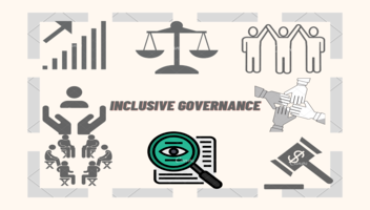
Building Capacities for Civic Engagement, Peacebuilding and Inclusive Dialogue: Towards Inclusive and Participatory Gove...
United Nations Development Programme, CambodiaOver the past two decades, Cambodia has made significant economic progress, with growth being over 7%. The opportunity exists to underpin this progress towards an inclusive and equitable social contract by strengthening social cap...
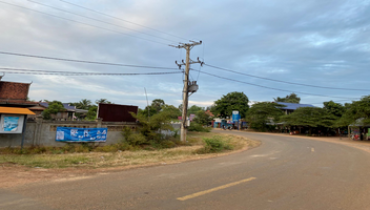
Local Leadership in Cambodia
Swedish International Development Cooperation AgencySince the end of the war, Cambodia has undergone significant social, economic and demographic change as well as governance reform. In 2002, the first local elections of the post-war era elected local government councils. This stud...
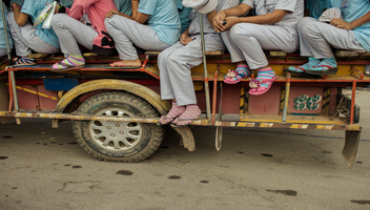
Social Protection and the Gendered Impacts of COVID-19 in Cambodia: Longitudinal Research to ‘Build Back Better’ in the...
UK Research and InnovationCOVID-19 pandemic has caused severe disruption of the global garment industry such as manufacturing shutdowns, consumer lockdowns, order cancellation of suppliers, and lack of raw materials. However, social protection in Cambodia...

Barriers and Pathways to Women's Political Participation in Myanmar: Gender Equality and Decentralization in Myanmar -Co...
Canada's International Development Research CentreWomen’s participation in politics has been an issue that remains to be addressed in order to achieve gender equality around the world. In Asia, while important progress has been made towards gender equality and where women are key...

Desk Study on EU-China's Development Cooperation in Cambodia
Swiss Agency for Development and Cooperation SwissIn this context of promoting Cambodia’s Sustainable Development Goals and aid effectiveness, and with the aim to inform the preparation of the next Joint European Strategy 2020-2024, European partners in Cambodia agreed to conduct...
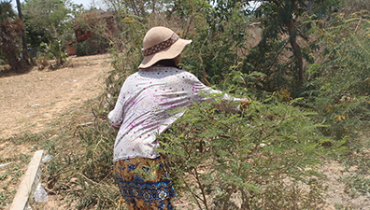
Focusing a Gendered Lens on Climate Resilience, Credit, and Malnutrition in Translocal Cambodia and South India
UK Research and InnovationThis project is cutting-edge research with innovative that addresses cross-cut topics and disciplines in developing holistic interventions and solutions to developing countries in Cambodia and India. This is collaborative researc...
There is no data list!
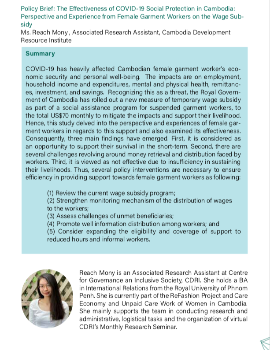
The Effectiveness of COVID-19 Social Protection in Cambodia: Perspective and Experience from Female Garment Workers on the Wage Subsidy
COVID-19 has heavily affected Cambodian female garment workers’ economic security and personal well-being. The impacts are on employment, household income and expenditures, mental and physical health, remittances, investment, and savings. Recognizing this as a threat, the Royal Government of Cambodia has rolled out a new measure of temporary wage subsidy as part of a social assistance program for...
Civil Society Organisations and Youth Civic Engagement in Cambodia
This working paper explores the evolving role of civil society organisations (CSOs) in promoting youth civic engagement in Cambodia amid shifting political dynamics following the 2013 national election. Drawing on qualitative data from three provinces and Phnom Penh, the study examines the strategies of three distinct organisations—an internationally funded NGO (A), an independent NGO (B), and a s...
Do Climate Uncertainties Trigger Farmers’ Out-migration in the Lower Mekong Region?
Many rural communities in the Lower Mekong region are vulnerable to the climate uncertainty induced by climate change due to high rate of poverty, lack of agricultural technology, and heavy reliance on the environment for their livelihoods. Rural people are likely to migrate to urban areas in response to the climate impacts and thanks to the rises in the number of cities, urban areas, and industri...
State Regulations and Elitisation: A Study of Civil Society Elites in Indonesia and Cambodia
This article analyses how and to what extent state regulation of civil society organisations (CSOs) have resulted in elitisation, i.e., the process of obtaining elite status within and beyond civil society. This is studied in the context of emerging democracy in Indonesia and shrinking civic space in Cambodia. Combining Bourdieu’s concepts of field and elite with strategic action fields, the artic...
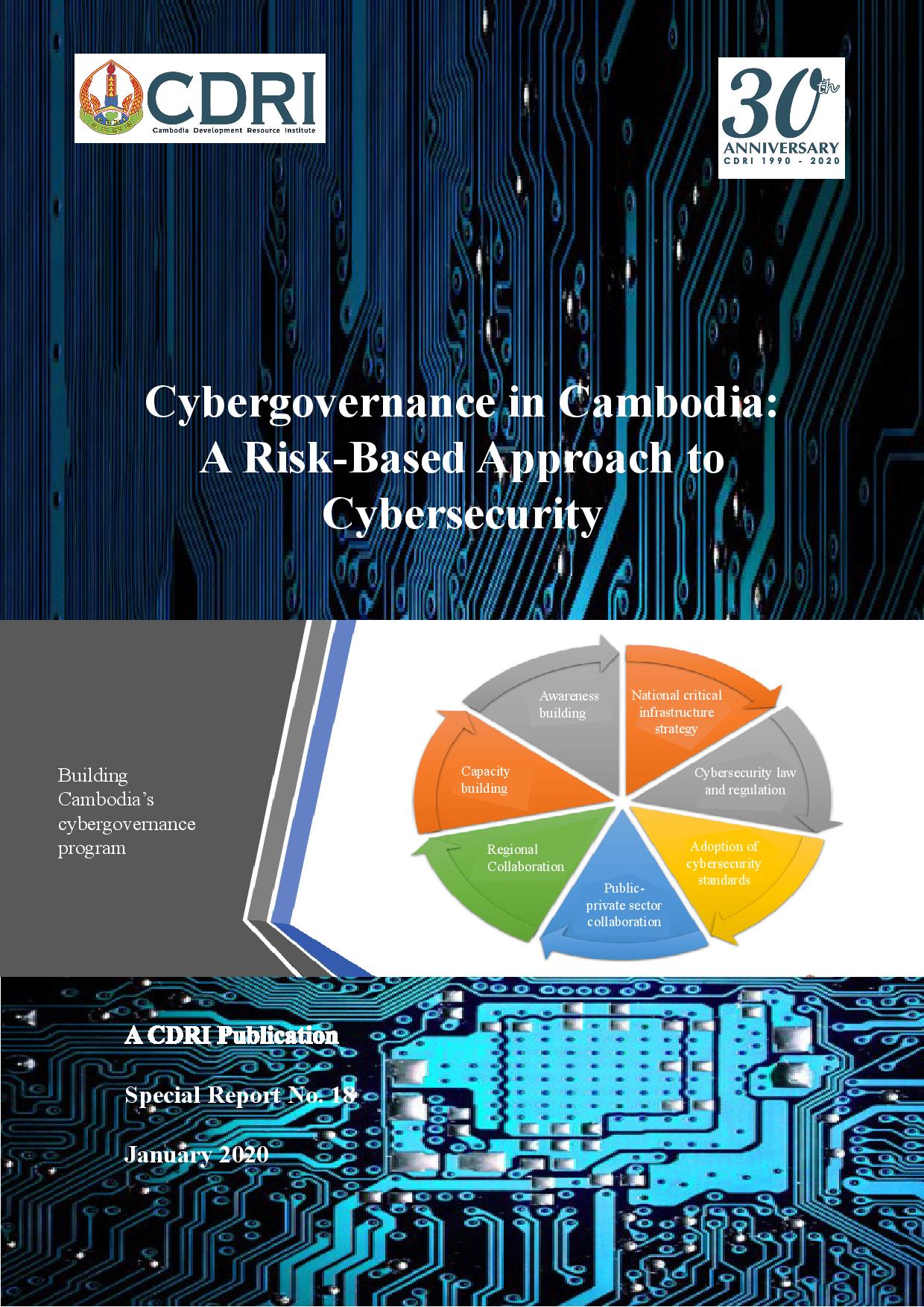
Cybergovernance in Cambodia: A Risk-Based Approach to Cybersecurity
To understand cyber risk in Cambodia and equip policy leaders to oversee it, this paper assesses the successes and challenges of current cyber risk management efforts in Cambodia and throughout the Association of Southeast Asian Nations (ASEAN) region. The findings suggest that there is a large gap between the rapid implementation of new technologies in Cambodia and the capacity to govern conseque...
Gender Analysis of Survey on Cambodia’s Young and Older Generation: Family, Community, Political Knowledge and Attitudes, and Future Expectations
This study presents a gendered analysis of a nationally representative survey of 1,600 Cambodians aged 16–65, conducted across rural and urban areas. It explores how women’s perceptions and participation in socio-political life vary by age, education, residence, employment, mobility, and internet use. The analysis focuses on four themes: family, community attitudes, political knowledge and attitud...
Cambodia’s Young and Older Generation: Views on Generational Relations and Key Social and Political Issues
Youth make up one-third of the Cambodian population. This generation was born after the Khmer Rouge years and has grown up with the idea of regular competitive elections in a multi-party system. The youth cohort forms an increasingly significant proportion of the national electorate. This report analyses the results from a nationally representative survey of Cambodian citizens’ family and communit...