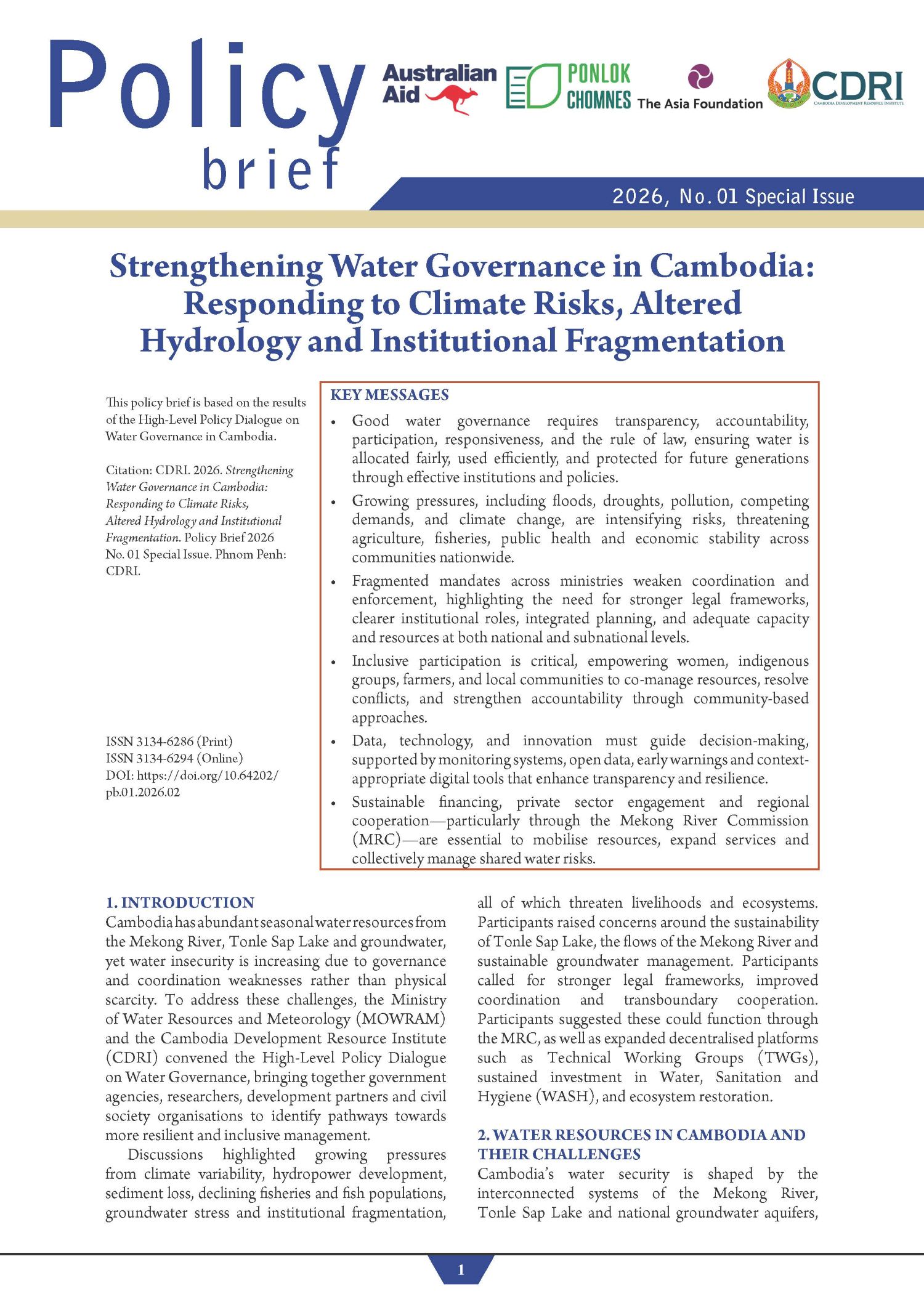
Strengthening Water Governance in Cambodia: Responding to Climate Risks, Altered Hydrology and Institutional Fragmentation
Keyword: Altered hydrology, climate risks, community-based approaches, institutional fragmentation, water governance
Khmer PDF (8)
Abstract/Summary
- Good water governance requires transparency, accountability, participation, responsiveness, and the rule of law, ensuring water is allocated fairly, used efficiently, and protected for future generations through effective institutions and policies.
- Growing pressures,
including floods, droughts, pollution, competing demands, and climate change,
are intensifying risks, threatening agriculture, fisheries, public health and
economic stability across communities nationwide.
- Fragmented mandates
across ministries weaken coordination and enforcement, highlighting the need
for stronger legal frameworks, clearer institutional roles, integrated
planning, and adequate capacity and resources at both national and subnational
levels.
- Inclusive
participation is critical, empowering women, indigenous groups, farmers, and
local communities to co-manage resources, resolve conflicts, and strengthen
accountability through community-based approaches.
- Data, technology, and innovation must guide decision-making, supported by monitoring systems, open data, early warnings and context-appropriate digital tools that enhance transparency and resilience.
- Sustainable financing, private sector engagement and regional cooperation—particularly through the Mekong River Commission (MRC)—are essential to mobilise resources, expand services and collectively manage shared water risks.
Related Publications
From Serial Discontinuity to Socio-ecological Resilience: A Conceptual...
08-Oct-2026
River ecosystem discontinuity and dysconnectivity are significant concern in transboundary river basins. Anthropogenic i...
The Political Ecologies of Managing Cambodia’s Tonle Sap Fisheries
11-Aug-2026
Situated in Cambodia, the Tonle Sap Lake (TSL) is the largest freshwater lake in Southeast Asia and the Mekong River Bas...
Hydrological Dynamics and Implications for Integrated Water Resources...
04-Aug-2026
Boeng Sneh Lake (BSL), a 3,924-hectare freshwater wetland in Cambodia’s Mekong Delta, is a critical water resource tha...