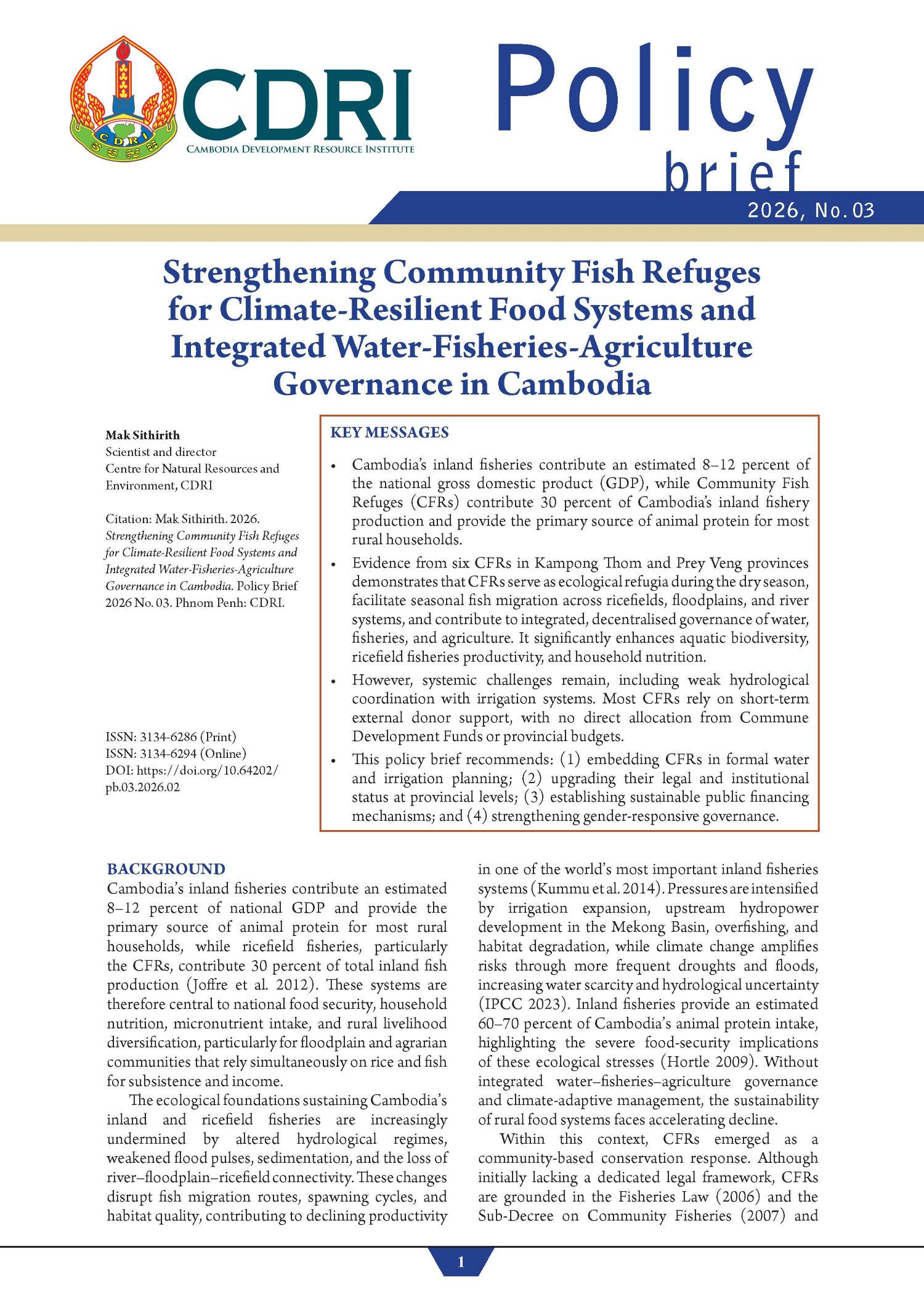
Strengthening Community Fish Refuges for Climate-Resilient Food Systems and Integrated Water-Fisheries-Agriculture Governance in Cambodia
Keyword: Community fish refuge, ecological connectivity, food system, floodplain, rice field
Abstract/Summary
- Cambodia’s inland fisheries contribute an estimated 8–12 percent of the national gross domestic product (GDP), while Community Fish Refuges (CFRs) contribute 30 percent of Cambodia’s inland fishery production and provide the primary source of animal protein for most rural households.
- Evidence from six CFRs in Kampong Thom and Prey Veng provinces demonstrates that CFRs serve as ecological refugia during the dry season, facilitate seasonal fish migration across ricefields, floodplains, and river systems, and contribute to integrated, decentralised governance of water, fisheries, and agriculture. It significantly enhances aquatic biodiversity, ricefield fisheries productivity, and household nutrition.
- However, systemic challenges remain, including weak hydrological coordination with irrigation systems. Most CFRs rely on short-term external donor support, with no direct allocation from Commune Development Funds or provincial budgets.
- This policy brief recommends: (1) embedding CFRs in formal water and irrigation planning; (2) upgrading their legal and institutional status at provincial levels; (3) establishing sustainable public financing mechanisms; and (4) strengthening gender-responsive governance.
DOI: https://doi.org/10.64202/pb.03.2026.02
Related Publications
From Serial Discontinuity to Socio-ecological Resilience: A Conceptual...
08-Oct-2026
River ecosystem discontinuity and dysconnectivity are significant concern in transboundary river basins. Anthropogenic i...
The Political Ecologies of Managing Cambodia’s Tonle Sap Fisheries
11-Aug-2026
Situated in Cambodia, the Tonle Sap Lake (TSL) is the largest freshwater lake in Southeast Asia and the Mekong River Bas...
Hydrological Dynamics and Implications for Integrated Water Resources...
04-Aug-2026
Boeng Sneh Lake (BSL), a 3,924-hectare freshwater wetland in Cambodia’s Mekong Delta, is a critical water resource tha...