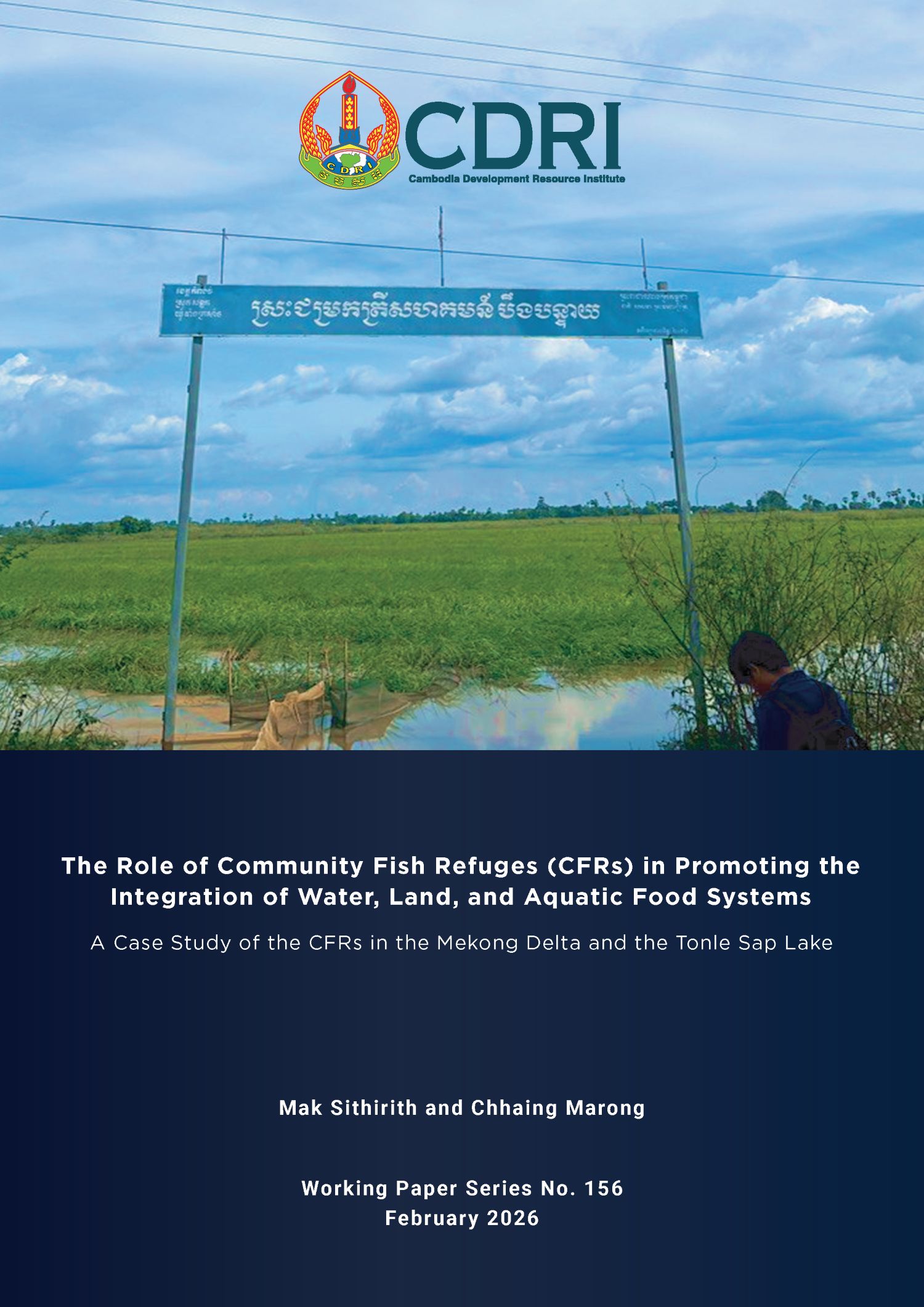
The Role of Community Fish Refuges (CFRs) in Promoting the Integration of Water, Land, and Aquatic Food Systems: A Case Study of the CFRs in the Mekong Delta and the Tonle Sap Lake
Keyword: Community fish refuge, ecological connectivity, food system, floodplain, rice field
Abstract/Summary
This working paper examines the role of Community Fish Refuges (CFRs) in promoting the integration of water, land, and aquatic food systems in Cambodia, drawing on six case studies in the Tonle Sap floodplain and Mekong Delta. Situated within rice-field and floodplain landscapes, CFRs function as dry-season refuges, wet-season spawning grounds, and hydrological connectors linking rivers, irrigation systems, and rice fields. Using mixed methods—including key informant interviews, focus group discussions, and participatory mapping—the study analyses ecological, hydrological, and governance dimensions of CFR systems. Findings show that perennial, seasonally expanding, and ephemeral CFRs perform complementary ecological functions that sustain fisheries productivity and biodiversity under changing flood regimes. Beyond conservation, CFRs contribute to irrigation management, rice farming, and local food security when embedded within integrated governance arrangements involving District Technical Working Groups and water user communities. The study concludes that CFRs represent viable landscape-level models for decentralised, climate-resilient resource governance in Cambodia’s floodplain and delta systems.
DOI: https://doi.org/10.64202/wp.156.202602
Related Publications
From Serial Discontinuity to Socio-ecological Resilience: A Conceptual...
08-Oct-2026
River ecosystem discontinuity and dysconnectivity are significant concern in transboundary river basins. Anthropogenic i...
The Political Ecologies of Managing Cambodia’s Tonle Sap Fisheries
11-Aug-2026
Situated in Cambodia, the Tonle Sap Lake (TSL) is the largest freshwater lake in Southeast Asia and the Mekong River Bas...
Hydrological Dynamics and Implications for Integrated Water Resources...
04-Aug-2026
Boeng Sneh Lake (BSL), a 3,924-hectare freshwater wetland in Cambodia’s Mekong Delta, is a critical water resource tha...