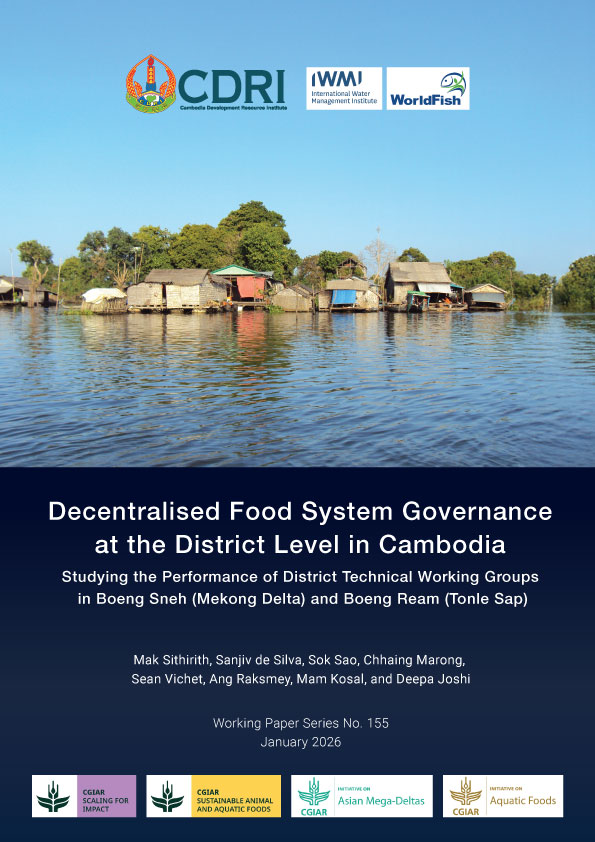
Decentralised Food System Governance at the District Level in Cambodia: Studying the Performance of District Technical Working Groups in Boeng Sneh (Mekong Delta) and Boeng Ream (Tonle Sap)
Keyword: District technical working groups, decentralised food system governance, Boeng Sneh, Boeng Ream, floodplain ecosystems
Abstract/Summary
This working paper examines
decentralised food system governance at the district level in Cambodia through
an assessment of District Technical Working Groups (DTWGs) established in Boeng
Sneh (Mekong Delta) and Boeng Ream (Tonle Sap). These floodplain ecosystems are
critical for rice production, fisheries, and rural livelihoods but face increasing
pressures from fragmented governance, water conflicts, and climate variability.
The study analyses DTWG performance across five governance dimensions—stakeholder
representation, coordination and integration, transparency and
accountability, behavioural and institutional change, and sustainability—using
interviews, focus group discussions, meeting records, and policy reviews.
Findings show that DTWGs improved water security, restored irrigation
infrastructure, reduced conflicts, and strengthened ecological conservation
through coordinated multi-stakeholder planning. They also enhanced
transparency, institutional learning, and community participation, including
women’s involvement. However, sustainability challenges remain, including
limited budgets, technical capacity gaps, and incomplete institutional
integration. The paper concludes that DTWGs represent an effective model for
integrated, decentralised governance, providing a scalable mechanism to
strengthen food security, climate resilience, and ecosystem sustainability in
Cambodia’s floodplain regions.
Related Publications
From Serial Discontinuity to Socio-ecological Resilience: A Conceptual...
08-Oct-2026
River ecosystem discontinuity and dysconnectivity are significant concern in transboundary river basins. Anthropogenic i...
The Political Ecologies of Managing Cambodia’s Tonle Sap Fisheries
11-Aug-2026
Situated in Cambodia, the Tonle Sap Lake (TSL) is the largest freshwater lake in Southeast Asia and the Mekong River Bas...
Hydrological Dynamics and Implications for Integrated Water Resources...
04-Aug-2026
Boeng Sneh Lake (BSL), a 3,924-hectare freshwater wetland in Cambodia’s Mekong Delta, is a critical water resource tha...