
Centre for Governance and Public Innovation
The Centre for Governance and Public Innovation (CGPI) conducts high-quality, policy-oriented research to strengthen institutional capacity, improve public sector performance, and support evidence-informed policymaking in Cambodia. The Centre generates practical knowledge that contributes to more effective, responsive, and innovative public institutions capable of meeting evolving development challenges. CGPI's research covers a broad range of governance priorities, with a central focus on public sector innovation. This includes public administration modernisation, decentralisation, public financial management, digital public services, and regulatory efficiency. The Centre actively examines how emerging technologies, artificial intelligence, and digital adoption can be leveraged to streamline processes, optimise public service delivery, and build future-ready governance frameworks. In addition to research, CGPI promotes knowledge exchange through policy dialogue, stakeholder engagement, capacity development, and strategic partnerships with government, development partners, academia, and the private sector. By bridging research, policy, and practice, the Centre supports the design and implementation of governance initiatives that are practical, responsive, and evidence-based. Through rigorous research and active policy engagement, CGPI aims to drive institutional modernisation, enhance service delivery, and support sustainable socio-economic development in Cambodia.
There is no data list!

Leadership Pathways for Local Women: Case Studies of Three Communes in Cambodia
Women’s leadership is necessary for Cambodia’s sustained development. Their involvement in leadership roles in the public sphere and politics is crucial and has been shown to impact positively on poverty reduction. Governments, NGOs and international organisations have been increasingly aware that sustainable development is significantly linked to gender equality and women’s empowerment, key facto...
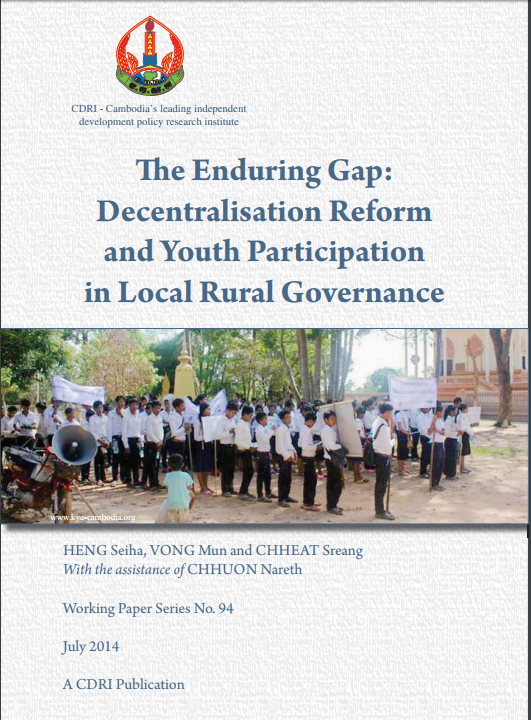
The Enduring Gap: Decentralisation Reform and Youth Participation in Local Rural Governance
To understand the contribution of the decentralisation reform to youth participation in local rural governance, this paper reviews empirically how youth have utilised the participatory opportunities enabled by the decentralisation reform based on three themes: civic, political and electoral. The findings suggest that despite decentralisation having been implemented for more tha...
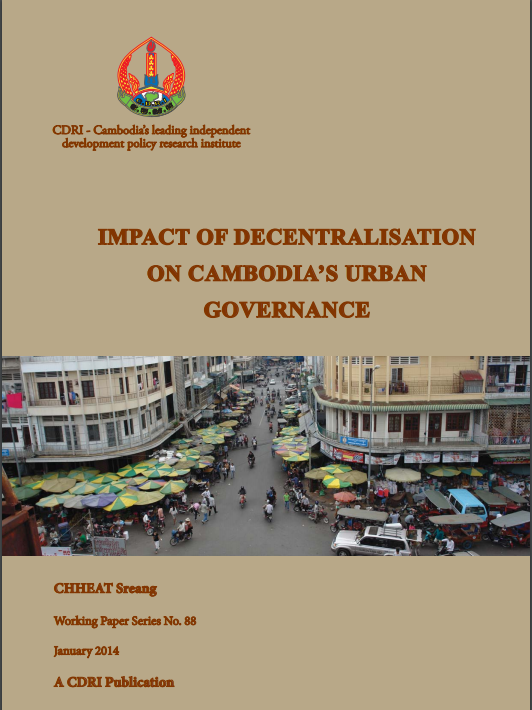
Impact of Decentralisation on Cambodia’s Urban Governance
This study explores the effects of decentralisation on urban governance in Cambodia, focusing on the role and performance of sangkats—the lowest administrative units in urban areas. While decentralisation has been promoted as a means to enhance local democracy, accountability, and service delivery, its implementation in urban contexts remains underexamined. Through qualitative fieldwork in Ph...
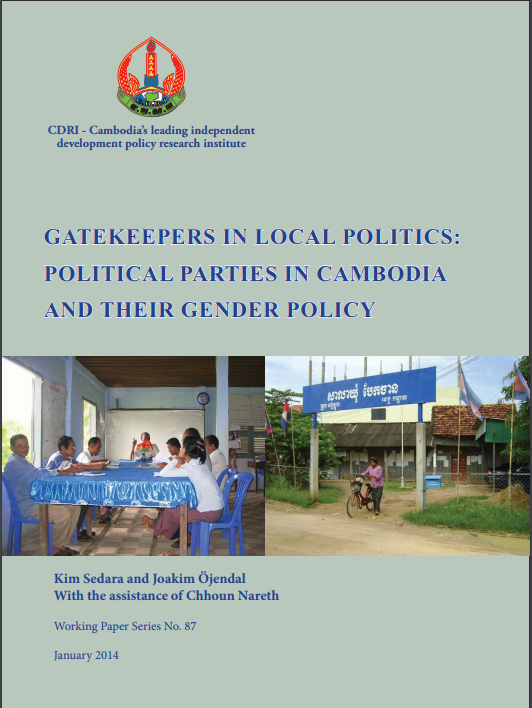
Gatekeepers in Local Politics: Political Parties in Cambodia and Their Gender Policy
Gender issues have become a part of mainstream Cambodian politics over the last decade, and gender-neutral electoral systems have been developed in cooperation between donors and government. Female representation has been achieved primarily through direct and indirect elections at different levels. And although Cambodia is a male-dominated culture in a patrimonial society, atte...
20 Years’ Strengthening of Cambodian Civil Society: Time for Reflection
In the 1980s and 1990s a large number of NGOs emerged in Cambodia, primarily in response to donors’ agendas on strengthening civil society to curb repressive developing country governments and support a broad democratisation process. Over the last 20 years, donor money has been concentrated on funding a small group of NGOs, mostly located in the country’s centre. While it is not argued that NGOs h...
Sub-National Civil Society in Cambodia: A Gramscian Perspective
Several authors (particularly Laundau 2008; Henke 2011) label Cambodian national civil society as a sphere that is neither apolitical nor autonomous, but influenced or co-opted by and blurred with the state. They posit that a Gramscian perspective is relevant to interpreting civil society in the country. This article suggests that the application of a Gramscian perspective also proves relevant to...