Abstract/Summary
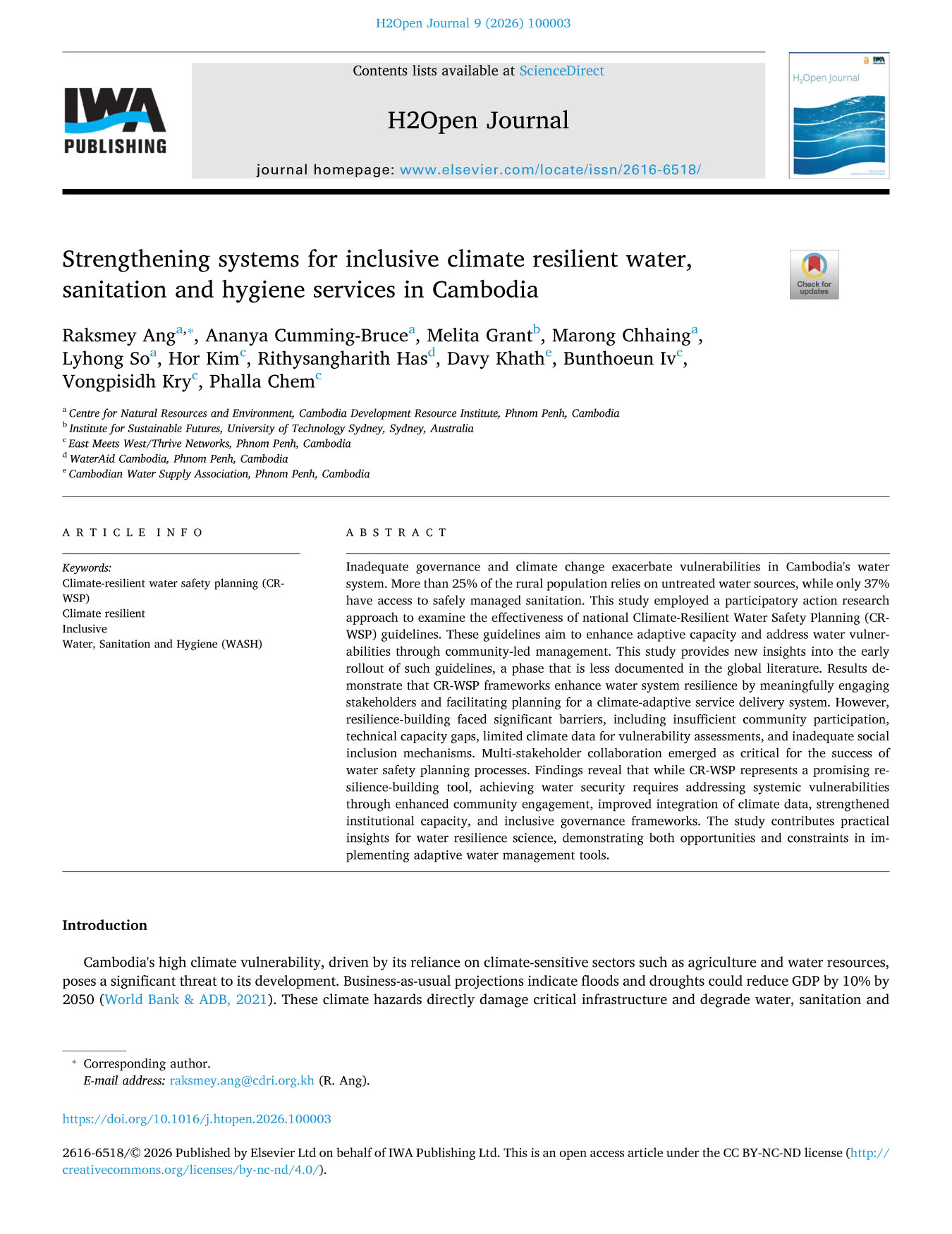
Inadequate governance and climate change exacerbate vulnerabilities in Cambodia's water system. More than 25% of the rural population relies on untreated water sources, while only 37% have access to safely managed sanitation. This study employed a participatory action research approach to examine the effectiveness of national Climate-Resilient Water Safety Planning (CR-WSP) guidelines. These guidelines aim to enhance adaptive capacity and address water vulnerabilities through community-led management. This study provides new insights into the early rollout of such guidelines, a phase that is less documented in the global literature. Results demonstrate that CR-WSP frameworks enhance water system resilience by meaningfully engaging stakeholders and facilitating planning for a climate-adaptive service delivery system. However, resilience-building faced significant barriers, including insufficient community participation, technical capacity gaps, limited climate data for vulnerability assessments, and inadequate social inclusion mechanisms. Multi-stakeholder collaboration emerged as critical for the success of water safety planning processes. Findings reveal that while CR-WSP represents a promising resilience-building tool, achieving water security requires addressing systemic vulnerabilities through enhanced community engagement, improved integration of climate data, strengthened institutional capacity, and inclusive governance frameworks. The study contributes practical insights for water resilience science, demonstrating both opportunities and constraints in implementing adaptive water management tools.
The full article is available at: https://www.sciencedirect.com/science/article/pii/S2616651826000035
Related Publications
From Serial Discontinuity to Socio-ecological Resilience: A Conceptual...
08-Oct-2026
River ecosystem discontinuity and dysconnectivity are significant concern in transboundary river basins. Anthropogenic i...
The Political Ecologies of Managing Cambodia’s Tonle Sap Fisheries
11-Aug-2026
Situated in Cambodia, the Tonle Sap Lake (TSL) is the largest freshwater lake in Southeast Asia and the Mekong River Bas...
Hydrological Dynamics and Implications for Integrated Water Resources...
04-Aug-2026
Boeng Sneh Lake (BSL), a 3,924-hectare freshwater wetland in Cambodia’s Mekong Delta, is a critical water resource tha...