
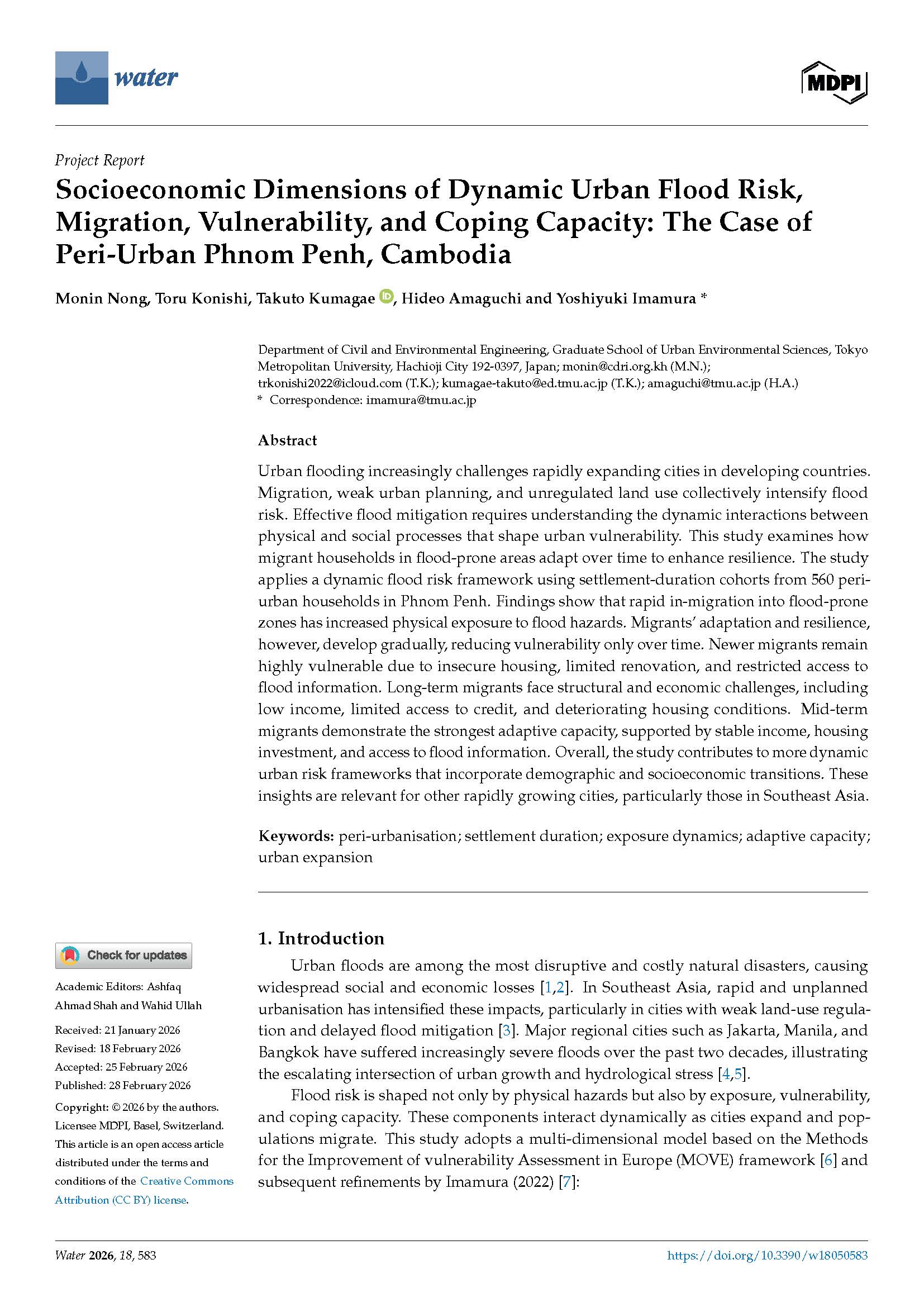
Socioeconomic Dimensions of Dynamic Urban Flood Risk, Migration, Vulnerability, and Coping Capacity: The Case of Peri-Urban Phnom Penh, Cambodia
Abstract/Summary
Urban flooding increasingly challenges rapidly expanding cities in developing countries. Migration, weak urban planning, and unregulated land use collectively intensify flood risk. Effective flood mitigation requires understanding the dynamic interactions between physical and social processes that shape urban vulnerability. This study examines how migrant households in flood-prone areas adapt over time to enhance resilience. The study applies a dynamic flood risk framework using settlement-duration cohorts from 560 peri-urban households in Phnom Penh. Findings show that rapid in-migration into flood-prone zones has increased physical exposure to flood hazards. Migrants’ adaptation and resilience, however, develop gradually, reducing vulnerability only over time. Newer migrants remain highly vulnerable due to insecure housing, limited renovation, and restricted access to flood information. Long-term migrants face structural and economic challenges, including low income, limited access to credit, and deteriorating housing conditions. Mid-term migrants demonstrate the strongest adaptive capacity, supported by stable income, housing investment, and access to flood information. Overall, the study contributes to more dynamic urban risk frameworks that incorporate demographic and socioeconomic transitions. These insights are relevant for other rapidly growing cities, particularly those in Southeast Asia.
The full article is available at: https://doi.org/10.3390/w18050583
Related Publications
From Serial Discontinuity to Socio-ecological Resilience: A Conceptual...
08-Oct-2026
River ecosystem discontinuity and dysconnectivity are significant concern in transboundary river basins. Anthropogenic i...
The Political Ecologies of Managing Cambodia’s Tonle Sap Fisheries
11-Aug-2026
Situated in Cambodia, the Tonle Sap Lake (TSL) is the largest freshwater lake in Southeast Asia and the Mekong River Bas...
Hydrological Dynamics and Implications for Integrated Water Resources...
04-Aug-2026
Boeng Sneh Lake (BSL), a 3,924-hectare freshwater wetland in Cambodia’s Mekong Delta, is a critical water resource tha...