
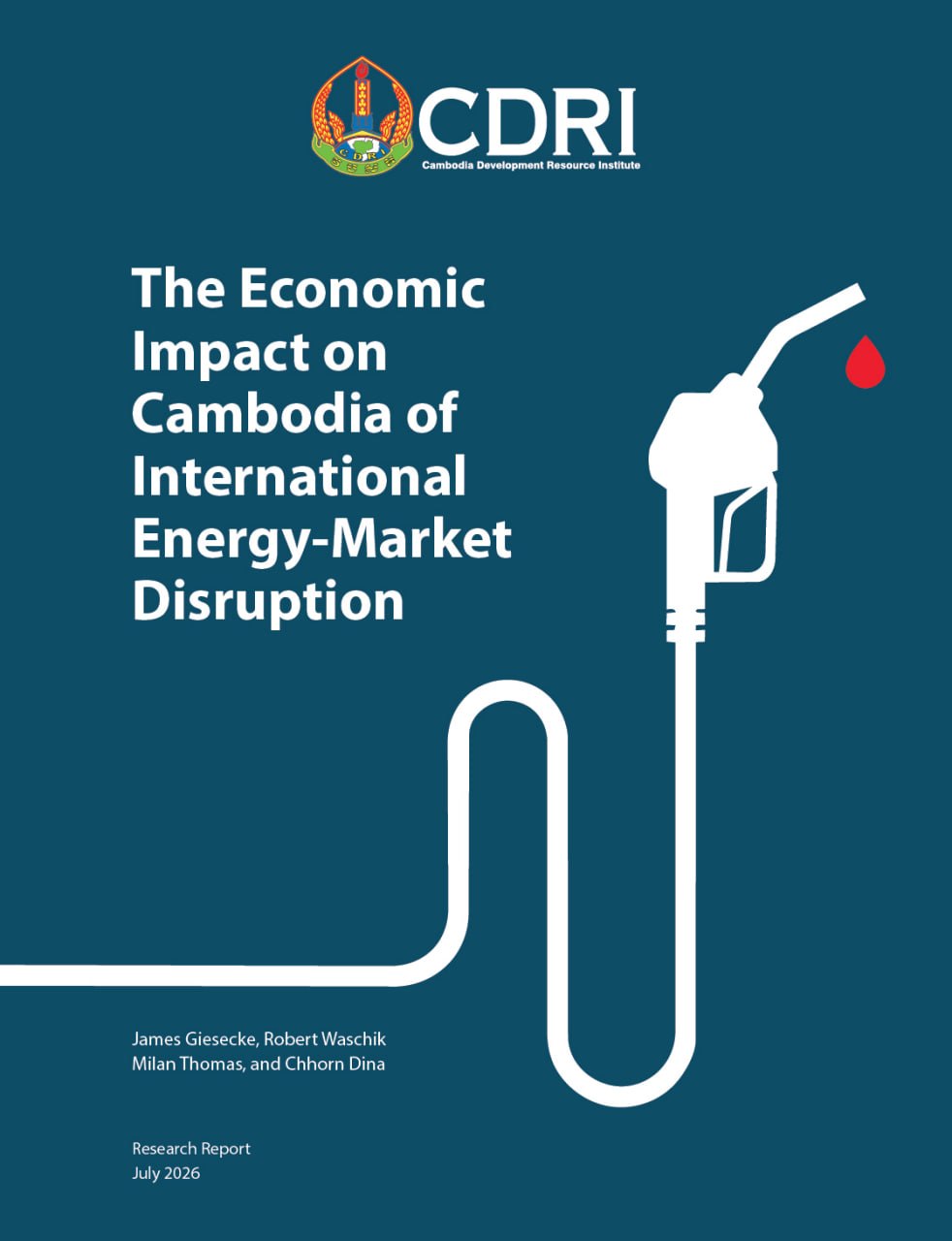
The Economic Impact on Cambodia of International Energy-Market Disruption
Keyword: Energy price shock, economic resilience, GTAP-FIN model, computable general equilibrium (CGE) analysis
Abstract/Summary
We use GTAP-FIN, a dynamic global computable general equilibrium model, to estimate the consequences for Cambodia of energy-market disruption originating in the Persian Gulf in 2026. We model two sets of shocks: a rise in prices for oil, gas, refined petroleum and chemicals, implemented via a productivity disruption to energy production in the Gulf and Arabian Peninsula region; and a set of restraints on exports of refined petroleum and fertiliser by China, Thailand and Vietnam, Cambodia's principal regional suppliers. Each is examined under light, moderate and severe scenarios over 2026 to 2031. The disruption reaches Cambodia through a deterioration in its terms of trade, as an importer of energy and chemicals with no domestic oil production. Under the moderate energy-price scenario, Cambodian real GDP falls 1.16 per cent below baseline in 2026 and real private consumption 3.93 per cent, with the largest sectoral contractions in construction and the investment-linked industries. A small group of trade-exposed sectors expands under the accompanying real depreciation. The two sets of shocks differ in their persistence: the energy-price effects attenuate as world prices moderate, while the export restraints impose a smaller but sustained loss. Across regions, the consumption outcome is explained by energy-trade position, with energy exporters cushioned and importers, including Cambodia, bearing the loss. Five priority policies emerge: accelerating renewable energy deployment and petroleum reserve management; adopting targeted fiscal transfers over broad fuel subsidies; establishing emergency fertiliser coordination; deploying trade-exposed sector gains toward electronics diversification; and scaling shock-responsive social protection through IDPoor and returnee channels.
DOI: https://doi.org/10.64202/rr.202607
Related Publications
The Role of Digital Platforms and Cross-Border Trade in Cambodian Firm...
30-Sep-2026
Digital platforms are reshaping how firms access markets, manage transactions and participate in international trade. In...
Determinants of Informal Borrowing: Evidence from Households in 11 Rur...
12-Jun-2026
Informal borrowing remains an important source of financing for rural Cambodian households, exposing them to exploitativ...
Economic Reintegration of Returnees and Border-Province Development St...
23-Feb-2026
Reintegration must move beyond employment numbers towards productivity and income recovery:Large-scale job matching in...