

News
07 August 2026From Access to Adoption: The Citizen Side of Cambodia's Digital Government Transition
Chunly Sereyvicheth, PhD
Director, Centre for Governance and Public
Innovation, CDRI
Key Messages:
- Cambodia's digital government challenge is now less about connectivity than citizen adoption: 76.9 percent of adults had not used a service.
- Two barriers—limited awareness and limited digital capability—together explain 92.1 percent of non-use.
- Different citizens need different responses: younger non-users lack awareness; older, less-educated ones need practical skills support.
- Delegated use should be recognised as a legitimate channel, with local officials, relatives, and intermediaries equipped to help citizens transact.
- Digital services deliver more value when front-end platforms are matched by back-end reforms that reduce paper and in-person requirements.
Cambodia has
experienced rapid digital transformation over the past decade. Mobile network
coverage extends across nearly all populated areas,
active cellular subscriptions exceed the total population, and
Cambodians have adopted commercial digital finance (mobile
money and banking applications) with remarkable speed.
As the
Kingdom advances its digital government agenda, set out in the Pentagonal Strategy-Phase I
and the Cambodia Digital Government Policy,
a different question comes into focus: how far citizens are engaging with the
digital channels the state has built. Much attention has gone to what is being
deployed. Less evidence exists on how citizens are receiving it.
Our new CDRI working paper
addresses that gap, drawing on a nationally representative survey of 1,200
Cambodian adults across twelve provinces, conducted face-to-face in January
2026. We found that more than three-quarters of respondents (76.9 percent) had
not used a government digital service in the preceding 12 months, while 21.4
percent had. The findings suggest this low uptake is associated less with
connectivity or technology itself than with gaps in awareness and digital
capability. But the data also reveals something deeper about how citizens
navigate the state: a strong reliance on human intermediaries, and the
lingering friction of paper-based bureaucracies.
Beyond Connectivity: Two Barriers, Not One
When asked for their main reason for not using a government digital
service, non-users gave practical answers: 57.1 percent said they did not know
how to use such applications, and 35.0 percent said they had not been aware the
services existed (Figure 1). Together, these account for 92.1 percent of
non-use. Concerns about data security (1.3 percent) and connectivity (1.0
percent) were marginal, and only 2.4 percent reported no need for government
services that year.
Figure 1:
Capability and awareness together account for 92.1 percent of non-use
Source:
CDRI Digital Government Citizen Survey, 2026.
The
awareness finding carries particular policy value: for roughly one-third of
non-users, the main constraint is simply not knowing that relevant services
exist.
The Same Gap, Different Citizens
These two
barriers are not evenly distributed, and this is where the findings prove
useful for programme design. Among non-users aged 16 to 25, 60.6 percent did
not know the services existed, while 26.6 percent pointed to a lack of skills
(Figure 2). Among those over 60, the pattern is close to reversed: 88.8 percent
cited skills and 5.6 percent awareness.
Figure 2:
The awareness barrier predominates among younger non-users; the skills barrier
among older ones
Source:
CDRI Digital Government Citizen Survey, 2026.
Where the Differences Lie—and Where They Do Not
Two further
results are notable for what they did not show. The first concerns geography:
rural and urban respondents reported similar levels of use (23.8 and 20.5
percent), a difference that is not statistically significant, and location did
not predict engagement once other characteristics were accounted for. Location
on its own does not distinguish users from non-users.
Where the
differences lie is in education and digital skills. Use jumped from 10.2
percent among those with primary schooling to 73.7 percent at the
post-secondary level, and from 7.7 percent among those who cannot install an
application to 40.3 percent among those who can. These statistically robust
disparities (Figure 3) demonstrate that independent digital adoption is
structurally gated by formal education and technical capacity. For the majority
of the population who fall below this threshold, direct, self-service
engagement with these platforms currently remains out of reach.
Figure 3:
Education and basic digital skills separate users from non-users far more
sharply than location does
Source:
CDRI Digital Government Citizen Survey, 2026.
Gender is also a comparable point. The
gap in reported use between women and men (19.7 against 23.9 percent) is not
statistically significant, but the gap in digital skills is larger and robust
(35.8 against 49.2 percent able to install an application unaided). Once
capability is accounted for, gender no longer predicts engagement, so where
gender differences arise, they operate through digital skills, which is where
policy attention would be most productive.
Delegated Use: A Channel in its Own Right
When asked what
they would do if they could complete a government transaction online, 11.4
percent would do it themselves on their phone, 69.2 percent would go in person,
and 19.4 percent would ask someone else, usually a relative or friend (9.6
percent) or a government official (8.4 percent), and occasionally a paid agent
(1.4 percent) (Figure 4).
Figure 4:
Roughly one in five citizens would reach a digital service through another
person
Source:
CDRI Digital Government Citizen Survey, 2026.
This middle group is interpreted as
citizens’ pathway to independent use, although the evidence suggests otherwise:
they come from lower education levels than even the majority who would attend
in person. Delegated use may be a necessary channel through which many citizens
access digital services, rather than the precursive step towards doing it
themselves.
Completing the Journey

Approximately
64.5 percent of respondents expected that even after submitting an application
online, they would still be required to visit a government office in person.
This widespread perception—held by users and non-users of digital government
services alike—plausibly reflects a genuine institutional reality rather
than a misconception. The finding suggests that digital front-ends in Cambodia
have advanced faster than the reform of legal and procedural back-ends. Because
wet stamps, ink signatures, and in-person verification often remain statutory
conditions for the legal validity of many civil documents, a stark
"front-end/back-end gap" emerges. When citizens anticipate that an
online application will not remove the physical steps required to complete a
transaction, the expected time savings shrink. Consequently, they weigh these
channels logically: if a physical visit is ultimately mandatory, the practical
utility of initiating the process digitally is significantly diminished.
Designing for How Citizens Engage
None of this
diminishes what has been achieved. The coverage, platforms, and policy
architecture are real accomplishments, and efforts such as the DG SuperApp (in
pilot since 2025) point in the right direction. The question now is how to
translate that investment into use.
Four
priorities follow. First, communicating service availability is a low-cost,
high-return
The
objective is not to convert every citizen into an independent application user,
but to build a state whose services work well however a citizen reaches them:
on a phone, through a trusted intermediary, or across a counter made faster by
the systems behind it.
Cambodia has
built the digital foundations. The next phase is about bringing citizens with
them.
This blog post draws on the CDRI working paper Autonomists, Delegators, and Traditionalists: How Cambodian Citizens Engage with Digital Government Services, based on a nationally representative survey of 1,200 adults across 12 provinces, conducted in 2026.
Related News

CDRI Board of Directors Meeting
04 November 2020The Board of Directors (BoD) of the Cambodia Development Resource Institute (CDRI) met at a virtual meeting on 3rd November 2020. All 10 existing BoD members attended and actively engaged in the deliberation and comments. For further information about CDRI BoD, please visit CDRI...

CDRI Deliveries Keynote at National Conference on Land and Natural Resources Governance
27 October 2020CDRI Senior Management was invited to deliver a key-note on the Land and Natural Resources Governance at the National Conference on Tuesday, October 27, 2020, at the Bassac II. It was attended by over 150 participants from the provinces, key ministries and departments, and repres...
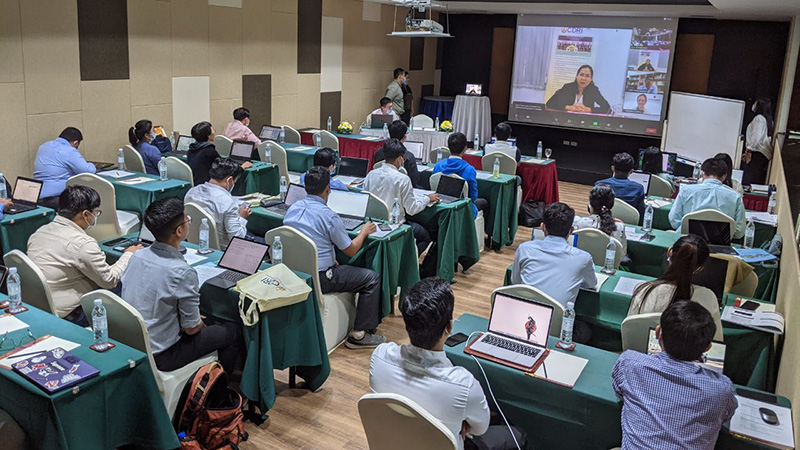
Training on Introduction to R for Quantitative Data Analysis
04 February 2021In collaboration with The Asia Foundation and under financial support from the Australian Department of Foreign Affairs and Trade (DFAT), the Centre for Educational Research and Innovation (CERI) has organizing a three-day intensive workshop on “Introduction to R for Quantitative...